

13 Feb Slinging Into Mes CHamoru 2026: Humåtak, Fouha Rock, and a Story That Started Long Before Magellan

Down in the south, where the mountains fall into the sea and the wind smells like salt and tångantångan, the village of Humåtak is getting ready again.
From February 27 – March 2, 2026, the Guam History & CHamoru Heritage Day Festival will turn this small bay into a living story—dancers, food, reenactments, music, and this year, a special slinging demo on March 1st (time TBA) to kick off Mes CHamoru.
But to really feel how powerful that is, you have to remember something important:
Our story did not start with Spain.
Our story started thousands of years before the first galleon ever touched these waters.
Long Before the Cross and the Crown
Before there were Spanish forts on the hills…
Before Magellan’s ships dropped anchor in Umatac Bay…
There were CHamoru sailors crossing open ocean in sakman and proa.
There were families planting, fishing, building latte houses.
There were children learning the stars, the winds, and the reef the way we learn ABCs today.
Archaeologists say that the first people of the Marianas arrived more than 3,000 years ago—long, long before the Spanish Empire even existed. For thousands of years, CHamorus lived on these islands as expert navigators, farmers, and fishermen, building a culture strong enough to survive everything that came later.
So when we talk about “history” in Humåtak, we’re not just talking about the Spanish era.
We’re also honoring the soul and curiosity of the ones who came first—our manamko from way back, who chose these islands and called them home.
Fouha Rock: Creation Point, Still Watching
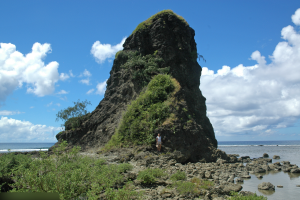
Just up the coast from Humåtak stands Fouha Rock, a tall stone pillar at Fouha Bay, sometimes called Creation Point.
According to the ancient story of Puntan yan Fu’una, the brother and sister gods:
- Puntan gives his body to create the universe—sky, sea, sun, moon.
- Fu’una throws herself into the earth and becomes a great stone.
- From that stone, the first CHamoru people emerge.
That stone is Fouha Rock.
Think about that. Long before anyone wrote “Guam” on a map, our ancestors looked at that rock and saw where humanity began for us. When we stand in Humåtak and look toward Fouha, we are looking at a place our people have honored for generations upon generations.
So when a slingstone flies across that same sky during Heritage weekend, it’s not just a “cool activity.”
It’s like tracing a line between who we were, who we are, and who we’re becoming.
Humåtak: Island Beauty, Layered History
Humåtak is one of those spots where you can see the layers of time:
- Ancient CHamoru presence in the land and sea, in the stories of creation, in the bones of the reef.
- Spanish-era forts and markers on the ridges, reminders of the time our islands were pulled into world empires.
- Modern Guam, with cars rolling through, kids on phones, visitors stopping to take photos.
During festival weekend, all those layers meet:
- Reenactments show the first contact with Magellan—not to make him a hero, but to remember what our people faced.
- Chamorro dance groups stomp, chant, and move stories that are older than any flag.
- Food tents serve up the flavors that survived centuries of change—kadon pika, tinala’ katne, latiya, titiyas, and more.
- And now, slinging steps forward as one of the main cultural highlights.
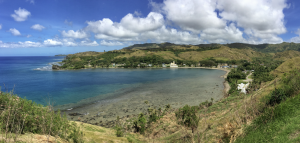
The bay itself is stunning—clear water curving into a quiet beach, mountains wrapping around like protective arms. When the sun hits the water just right, you can almost imagine the old sakman sailing in, loaded with breadfruit and stories.
Slinging: From Warrior Skill to Cultural Compass
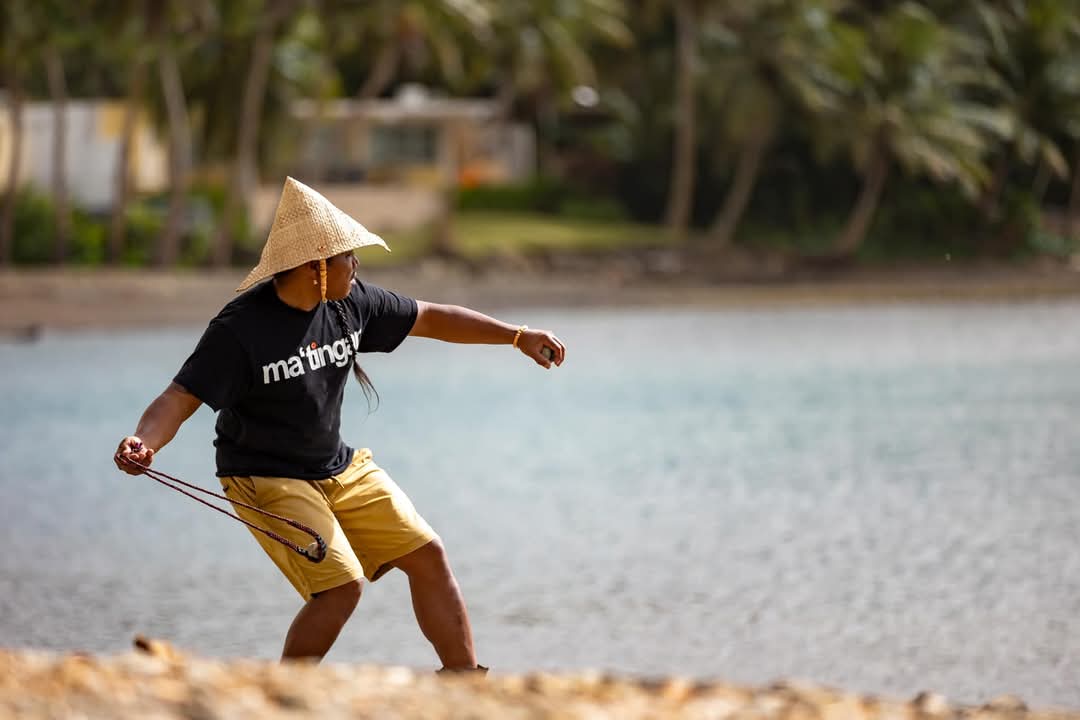
For ancient CHamoru warriors, the åcho’ atupat—the slingstone—was a serious tool. Stones carved to sharp points, slings braided from fiber, and throws accurate enough to defend villages and hunt for food.
Today, that same slingstone shape:
- Sits on our flag
- Hangs from necklaces
- Gets tattooed on skin
- Pops up in logos, murals, and monuments
It reminds us that our people weren’t just “islanders on a rock”—they were smart, technical, creative, and highly skilled.
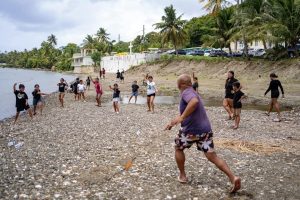
When we bring slinging demos into the Humåtak festival and Mes CHamoru, we turn that history into a hands-on lesson:
- Kids learn how to stand, breathe, focus, and release.
- They hear words like åcho’ atupat and atupat, and those words stick because their muscles remember the motion.
- Teachers can connect science (force, angle, trajectory) with culture (ancestors, survival, respect).
A sling in the hand becomes a compass pointing backward to our roots and forward to our future.
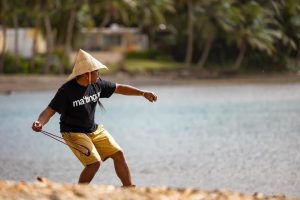
March 1st: The First Stone of Mes CHamoru
Mes CHamoru—CHamoru Month—runs through March, celebrating language, culture, and identity in schools, villages, and across the island.
This year, March 1st lands right inside the Humåtak festival weekend. That’s the day a slinging demo (time TBA) will join the lineup of:
- Cultural reenactments
- Musical performances
- Traditional games
- Storytelling and talks
If the whole month is a journey, then that slinging demo is like the first stone we send flying into Mes CHamoru—a powerful way to start 31 days of remembering and reconnecting.
We’re saying:
We were here before the ships.
We’re still here now.
And we plan to be here for a long time to come.
Slinging As a Metaphor for the Marianas
Slinging is more than a contest. It’s a picture of our islands:
- You plant your feet in the land your ancestors walked.
- You load your sling with everything they handed down—faith, humor, toughness, love.
- You aim toward a future where your kids speak their language, know their history, and carry themselves with pride.
- You release, trusting your training, your elders, and your own courage.
Sometimes we miss—colonial trauma, loss of language, disconnection.
But like any good slinger, we adjust our stance… and we throw again.
Humåtak’s Heritage weekend, and the slinging demo inside it, is one of those throws.
Si Yu’us Ma’åse: To the People Still Pulling the Sling Back
From the heart, si Yu’us ma’åse to:
- The Humåtak Mayor’s Office and all their partners for keeping the festival strong and rooted in real history, not just surface-level shows.
- The slinging community—cultural leaders, coaches, and practitioners who keep shaping this ancient art into something the next generation can hold.
- The teachers and schools who choose to bring their students all the way down south to learn by doing, not just reading.
- The families and manåmko’ who support, share stories, and keep the spirit respectful and fun.
- The visitors who are willing to go beyond selfies and truly connect with the land and its people.
You are all helping pull the sling back a little farther, giving our culture more power and reach.
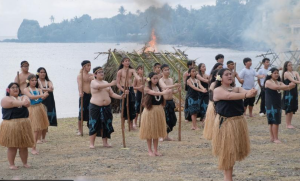
Come Stand Inside the Story
So when February 27 – March 2, 2026 comes around, don’t just drive past Humåtak.
Come down.
Feel the breeze off the bay.
Look toward Fouha Rock.
Listen to the drums, the chants, the laughter.
And when the slinging demo is announced on March 1st, step a little closer.
Because down there on that sand, with the ocean in front of you and thousands of years behind you, you’ll realize:
We are not just remembering history.
We are the continuation of it—
stone by stone, throw by throw, generation by generation.